
Rosa Weber · 19 September 2026
Spotlighting Cross-Border Compliance Shifts and Their Effects on App-Driven Onboarding Guides for New Sector Entrants
Data from regulatory bodies shows that cross-border compliance requirements have undergone notable revisions in recent years, with updates to data protection and identity verification standards reshaping how mobile applications handle user entry processes for new participants in various industries. Researchers at institutions tracking international policy developments note that these adjustments often focus on harmonizing rules across jurisdictions while addressing gaps in digital verification methods that apps rely upon during initial setup phases.
Regulatory Landscape Changes Across Regions
European authorities implemented refinements to the General Data Protection Regulation enforcement mechanisms in late 2025, which carried forward into September 2026 with expanded scrutiny on cross-border data transfers within onboarding sequences. Observers from the European Data Protection Board report that these measures require apps to incorporate real-time consent logging and automated deletion triggers that align with multiple member state interpretations simultaneously. Meanwhile Canadian federal agencies updated their Personal Information Protection and Electronic Documents Act guidelines to emphasize secure API integrations for identity checks, creating parallel demands on application developers serving North American markets.
Australian regulators through the Office of the Australian Information Commissioner introduced modifications to privacy codes that affect how onboarding flows collect and store location-based data, and these took effect alongside similar shifts in Singapore's Personal Data Protection Commission framework. Studies from academic centers analyzing these patterns indicate that such synchronized yet distinct requirements force application teams to build modular compliance layers rather than single-region solutions.
Direct Impacts on App-Driven Onboarding Sequences
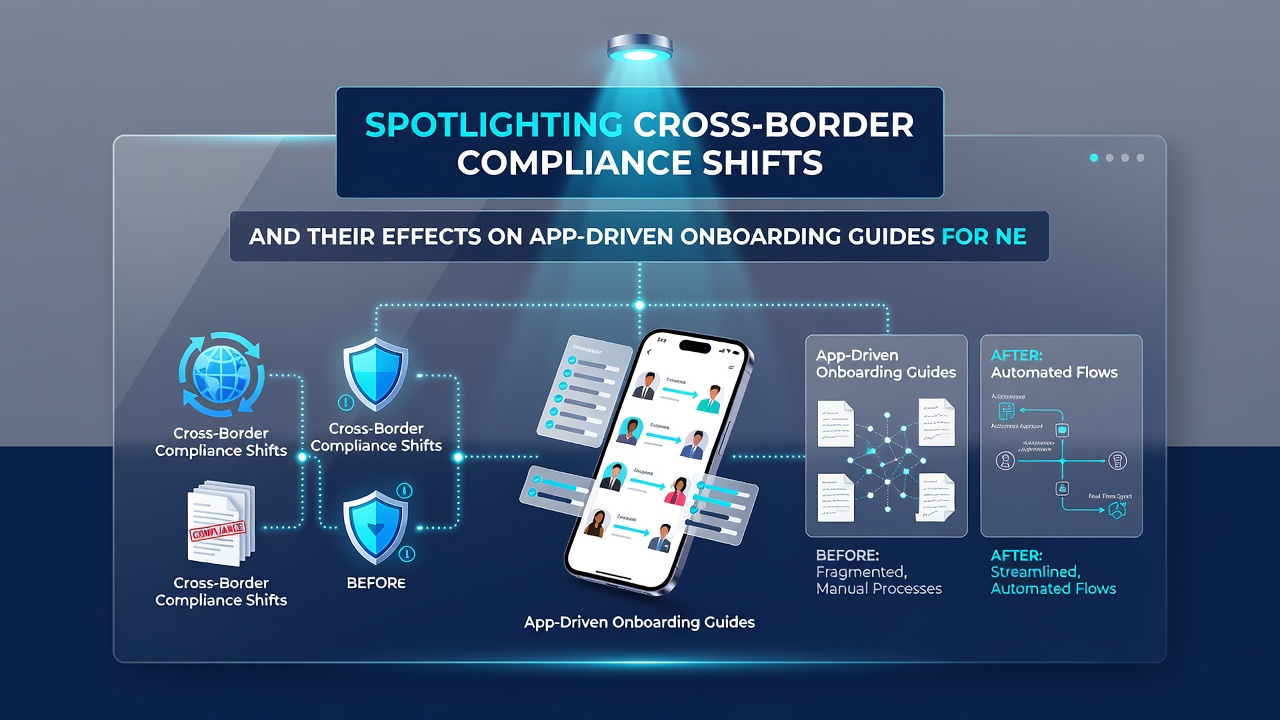
Application developers have responded by redesigning guided entry processes to embed jurisdiction-specific checks at multiple points instead of relying on static templates. For instance one analysis of fintech sector entrants revealed that apps now segment user journeys based on detected IP addresses and declared locations, triggering different verification modules that satisfy both European and Asian standards within the same session. This approach reduces completion drop-off rates while meeting mandates for explicit consent collection at each data handling stage.
Evidence from industry reports highlights that onboarding guides increasingly feature dynamic forms that adjust question sets according to the user's declared country of operation, pulling from centralized rule engines updated quarterly. Those who have examined deployment logs note that September 2026 saw a measurable uptick in such adaptive designs following coordinated announcements from multiple oversight bodies.
Technical Adaptations and Implementation Patterns
Developers integrate third-party verification services that support multi-jurisdictional compliance out of the box, allowing new sector participants to launch with pre-vetted modules rather than building custom layers from scratch. Research indicates these services often maintain separate data residency options that mirror requirements from bodies like the US Federal Trade Commission and the UK's Information Commissioner's Office without overlapping user data pools. Teams handling global rollouts therefore configure conditional logic that routes verification requests through the appropriate regional endpoint based on user input.
Case documentation from several technology providers shows that onboarding timelines for new entrants shortened when applications adopted these layered verification paths, although initial setup demanded extensive mapping of regulatory text into code parameters. Observers note that this mapping process typically involves collaboration between legal specialists and engineering groups to translate requirements such as data minimization and retention limits into automated workflows.
Challenges for New Market Participants
New entrants frequently encounter hurdles when attempting to scale across borders because legacy onboarding flows lack the flexibility to accommodate simultaneous compliance with divergent rules on biometric data handling and age verification thresholds. Figures released by trade associations tracking digital services reveal that applications without modular designs experience higher rejection rates during regulatory audits conducted in 2026.
Training resources for these teams have expanded to include scenario-based modules that simulate cross-border entry sequences, helping staff identify where single-region assumptions break down. Data compiled by research organizations demonstrates that participants who complete such exercises deploy compliant applications more rapidly than those relying solely on generalized documentation.
Conclusion
Cross-border compliance shifts continue to influence the architecture of app-driven onboarding guides as regulators refine enforcement around data flows and identity assurance. Organizations entering regulated sectors track these developments through official channels and integrate responsive features that address multiple jurisdictions within unified user experiences. This ongoing alignment between policy updates and technical implementation supports smoother market entry while maintaining adherence to evolving standards across regions.